
Framework Biodiversity Management Plan Blue Solar 2 & 3 Solar PV Projects, Albania
Albania
1. Introduction and Purpose
This Framework Biodiversity Management Plan (BMP) has been prepared for the Blue 2 and Blue 3 Solar PV Projects located in the Municipality of Fier, Albania. SPV Blue 2 Sh.p.k and SPV Blue 3 Sh.p.k(the Borrowers) are developing the Projects in Fier Municipality, Albania. The Projects comprises Blue Solar 2 Phase 1 (64 MWp, operational), Blue Solar 2 Phase 2 (55 MWp, under construction), and Blue Solar 3 (43 MWp, pre-construction), together with associated infrastructure including substations, underground electrical connections, a 30 MW / 80.25 MWh Battery Energy Storage System (BESS), and a 3.8 km, 220 kV overhead transmission line (OHTL) connecting the facilities to the national grid.
Environmental and Social Impact Assessments (ESIAs), biodiversity baseline studies, Critical Habitat Assessments (CHAs) and an external environmental and social due diligence (ESDD) have been completed for both Projects. These works identified a range of biodiversity features of conservation importance associated with the wider project landscape, including Priority Biodiversity Features (PBFs), natural habitats, wetland habitats, coastal dune systems, drainage channels, and species of conservation concern.
The assessments concluded that biodiversity impacts are expected to be site-specific and manageable through implementation of appropriate mitigation, monitoring, and adaptive management measures. Additional seasonal avifauna surveys, strengthened biodiversity monitoring, and implementation of bird collision mitigation measures for the OHTL will be undertaken in accordance with the Environmental and Social Action Plan (ESAP).
This Framework Biodiversity Management Plan (BMP) has been prepared to support alignment with EBRD Environmental and Social Requirement 6 (ESR6) and to provide a high-level biodiversity management framework for the Project. The Framework BMP forms part of the Project Environmental and Social Management System (ESMS) and establishes the overarching biodiversity management commitments for the Project. It is supported by the previously completed Project ESIAs, Critical Habitat Assessments (CHA), Biodiversity Action Plan (BAP), Environmental and Social Action Plan (ESAP), and other management plans prepared under the ESMS.Prior to completion of Blue Solar 2 Phase 2 and construction of Blue Solar 3, this Framework BMP will be expanded into a project-specific Biodiversity
Management Plan. Where required, topic-specific management plans (e.g. Habitat Restoration Plan, Avifauna Monitoring Plan or OHTL Bird Collision Management Plan) will be prepared to support implementation of the commitments presented in this Framework BMP.
The purpose of this Framework BMP is to:
- Define the Project’s biodiversity management commitments and approach
- Establish the application of the mitigation hierarchy (avoid, minimise, restore, and enhance);
- Identify key biodiversity survey, monitoring, and adaptive management requirements; and
- Define the framework for biodiversity management implementation during construction and operation.
This Framework BMP applies to Blue Solar 2, Blue Solar 3, the BESS facility, associated infrastructure, and the OHTL. The Framework BMP will guide the development of a detailed project-specific Biodiversity Management Plan prior to construction of Blue Solar 3 and completion of Blue Solar 2 Phase 2.
2. Biodiversity Context and Key Risks
The Project is located within a modified coastal landscape in Fier Municipality comprising agricultural land, disturbed grassland, drainage channels, saline habitats, and wetland features associated with the wider Karavasta coastal system. Blue Solar 2 partially overlaps the Karavasta Important Bird and Biodiversity Area (IBA/KBA), although not within the core wetland habitats, while Blue Solar 3 is located approximately 1.4 km from the designated area (Figure 1).
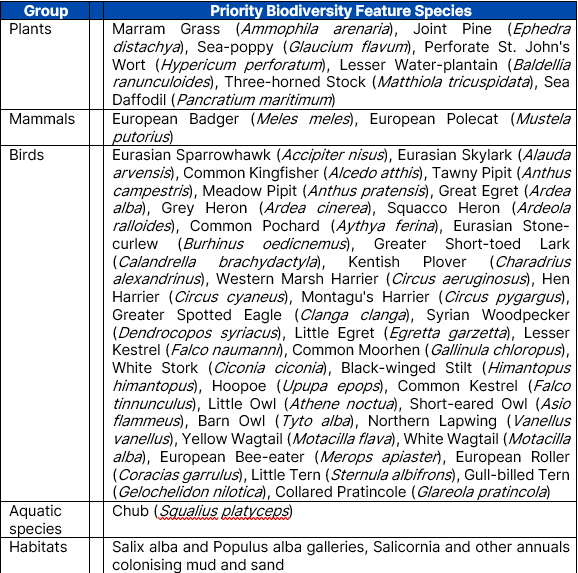
Biodiversity baseline studies and CHAs identified a range of possible critical habitats and priority biodiversity features (PBF) associated with the wider project landscape, linked to coastal and wetland habitats, drainage channels and temporary wetland features, and species of conservation concern associated with the Karavasta ecosystem. The EAAAincludes potentially 17 CH qualifying species (Table 1), and 49 species and 2 habitats qualifying as PBFs (Table 2).
The OHTL represents the primary long-term avifauna impact driver (via collision) associated with the Project and will therefore be subject to targeted mitigation and monitoring measures, including installation of bird flight diverters and operational monitoring.
The Project commits to:
- Applying the mitigation hierarchy;
- Achieving No Net Loss of natural habitat values or Net Gain for critical habitat;
- Avoiding impacts to Priority Biodiversity Features wherever practicable;
- Implementing additional surveys and monitoring identified in the BAP;
- Implementing OHTL bird collision mitigation measures;
- Applying adaptive management where monitoring identifies unanticipated impacts.
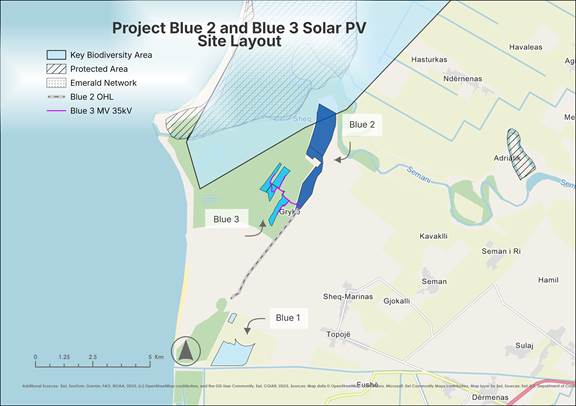
Table 1. CH-qualifying species identified for the project in EAAA
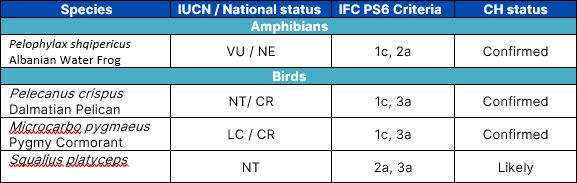
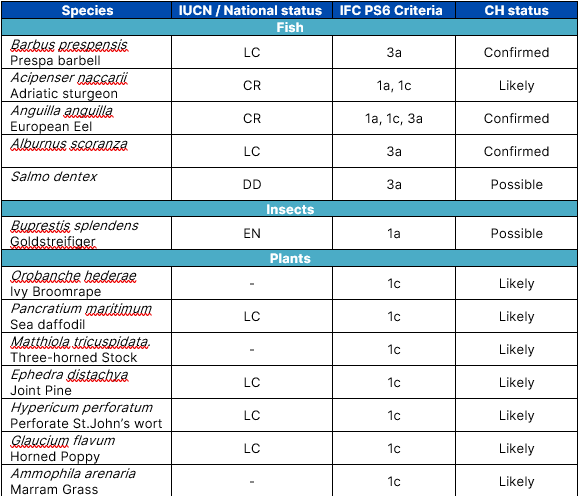
Table 2. Qualifying priority biodiversity features (PBF) identified for the project
3. Biodiversity Management and Monitoring Framework
The biodiversity management and monitoring framework for the Project is summarised in this section. The Project will apply the mitigation hierarchy of avoidance, minimisation, and restoration, supported by adaptive management throughout the Project lifecycle in accordance with EBRD Environmental and Social Requirement 6 (ESR6) and international good practice. Biodiversity management measures must be integrated into the Project Environmental and Social Management System (ESMS), contractor management procedures, construction management plans, and operational procedures.
The biodiversity impact pathways identified through the ESIAs, CHAs, and ESDD, are presented in Table 3. To facilitate implementation and reporting, these impacts have been grouped into a series of biodiversity management themes, which form the basis of the Biodiversity Management and Monitoring Framework presented in Table 4.
Table 4 defines the key biodiversity management commitments for each management theme, including the applicable mitigation hierarchy measures, implementation requirements, monitoring and reporting obligations, responsibilities, and biodiversity performance objectives. The framework is intended to provide a clear line of sight between identified biodiversity risks, management actions, monitoring requirements, and accountability throughout the Project lifecycle.
Adaptive management triggers are presented in Table 5. These triggers establish the circumstances under which mitigation measures, monitoring programmes, or management approaches will be reviewed and, where necessary, revised in response to monitoring results, incident investigations, new biodiversity information, or unforeseen impacts.
Biodiversity monitoring results will be used to periodically review residual impacts and evaluate progress towards achieving the applicable biodiversity performance objective (No Net Loss or Net Gain). Where restoration, compensation or offset measures are required, an annual loss/gain assessment will be undertaken until biodiversity performance objectives have been demonstrated. Results will be incorporated into annual biodiversity monitoring reports and used to inform adaptive management.
Table 3. Biodiversity Impact Register
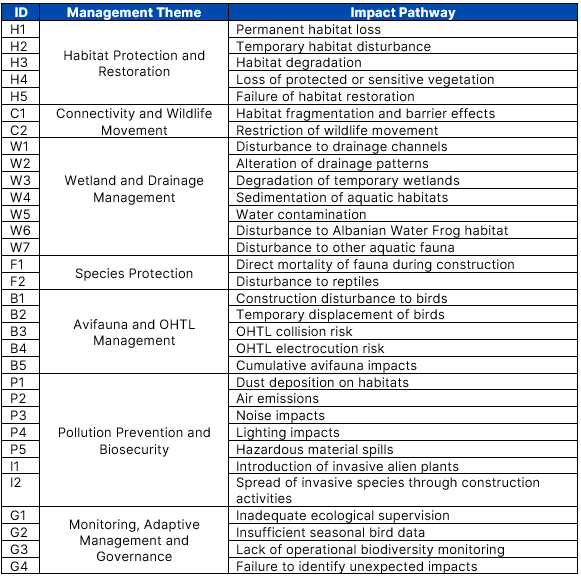
Table 4. Framework Biodiversity Management Plan
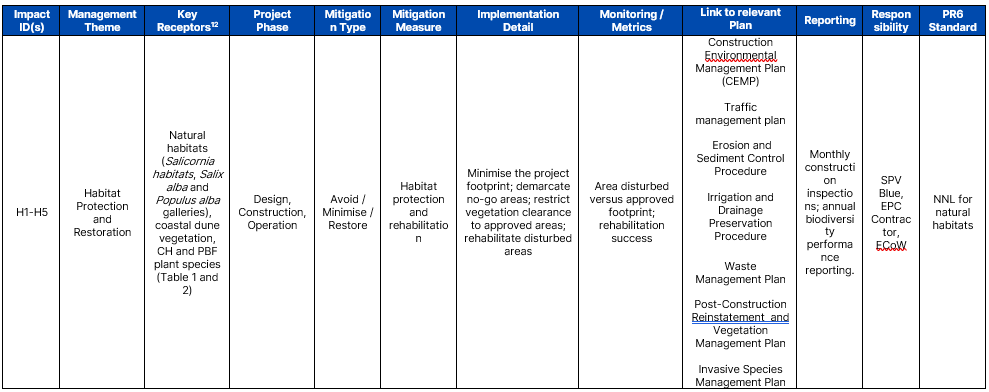
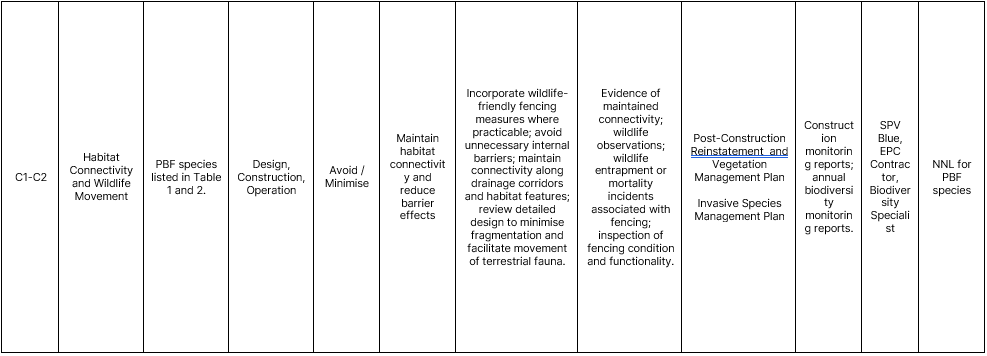
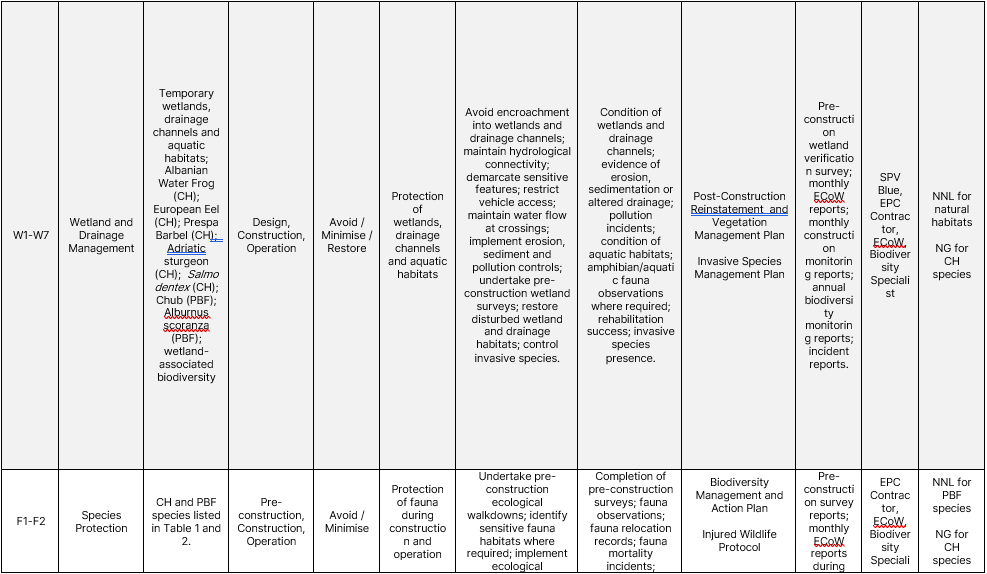
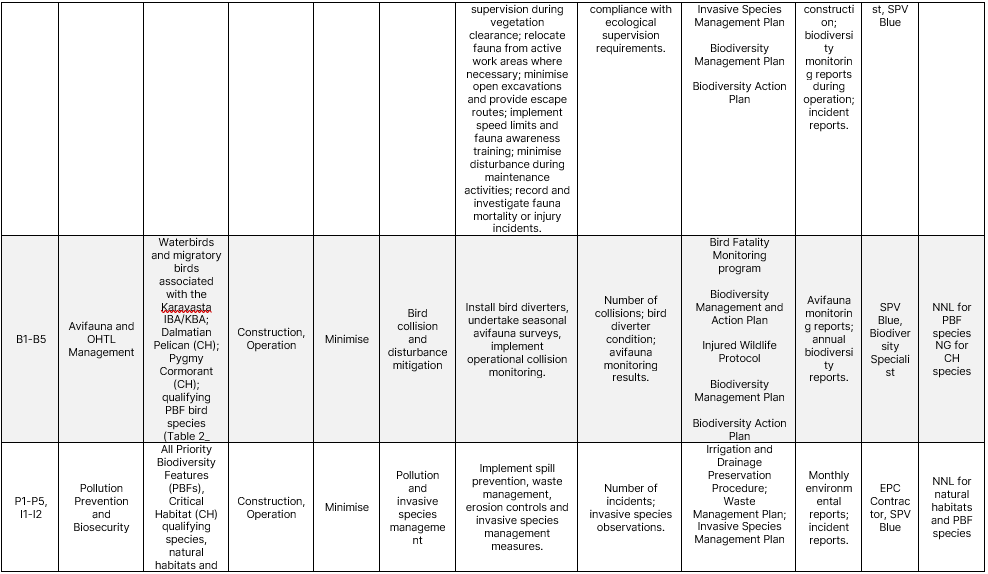
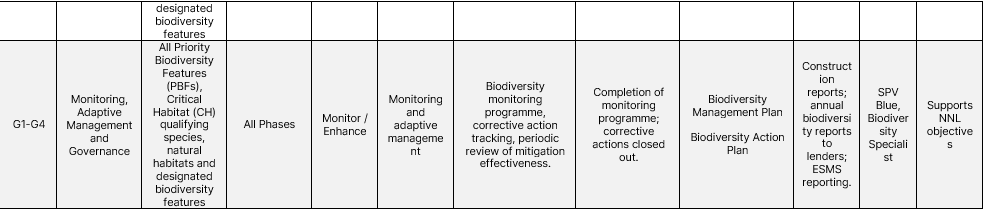
Table 5. Adaptive Management Triggers
